· 3 min read
Last Month (Jan26) with Claude Code
All built with Claude Code with some tweaking. Focusing on solving real problems rather than fighting boilerplate.
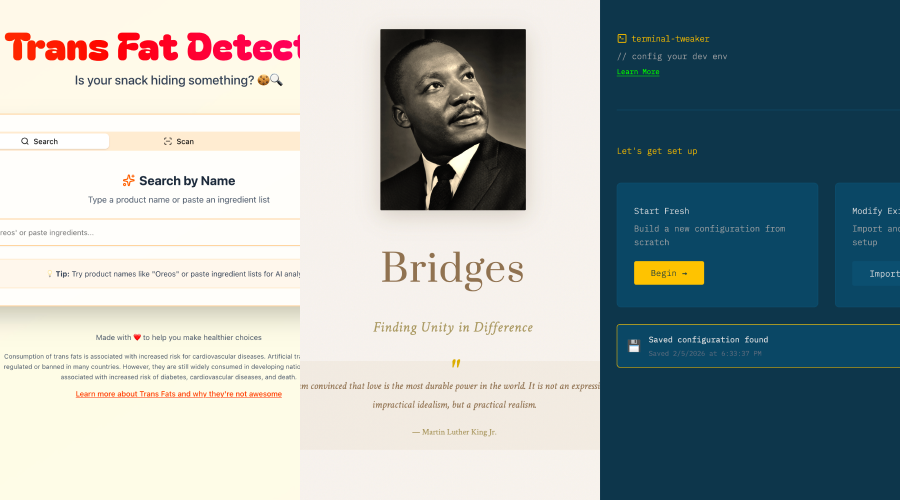
Three Apps, One Month
I shipped three things in January and I’m of proud of them. 👏
All three came from Claude Code. Different problems, different solutions, some people care, some people could care less, some don’t know. I think the things show something interesting about what happens when using ai.
TransFat Detector
https://transfat-detector.vercel.app/
Ok nutrition facts. There is a row for trans fat and the value is 0g. I thought why is this even here?
Turns out there is a loophole for trans fats in the US. The FDA allows food manufacturers to round down trans fat content to zero if it contains less than 0.5 grams per serving. This means a product can claim “0g trans fat” on the nutrition label even if it actually contains up to 0.49 grams per serving.
Can I point my phone at a label and get a straight answer?
Point your camera at a nutrition label, get an instant yes/no on trans fats plus context for everything else on the label. Works for people managing dietary restrictions, like to avoid loopholes, parents, anyone who just wants to be told the truth when they look at something. 😍
Bridges
https://mlk-app.vercel.app/
On MLK day this year I wanted to give back. I want harmony. I want people to love each other.
Most of the time, people care about the same things. They just see things differently or see different paths forward.
You feed it two opposing viewpoints. Environmental advocates vs. fossil fuel workers. Progressives vs. conservatives. Claude digs past the surface and shows you what actually connects them. The shared values. The common ground that exists beneath the argument.
I wanted it to feel thoughtful, not flashy. Sepia and serif, typography that nods to MLK’s time but doesn’t feel historical. The whole thing’s designed to reward slowing down, not speed.
I want you to help out, do something better than this, make this better. As a species we grow together, so we don’t grow apart.
Terminal Tweaker
https://terminal-tweaker.vercel.app/
New computer. Lots of dotfiles. The thought of manually recreating my entire terminal setup—hunting through configs, remembering which file does what, tweaking the shell until it looked right—felt like pointless friction.
Instead of doing it, I built an app to never do it again.
Terminal Tweaker lets you customize your terminal visually. Real-time preview of your prompt. Themes, preset aliases, Neovim configs. You click, you see what it looks like, you adjust. When you’re happy, you export and it’s ready to go.
Terminal customization is visual design. The app just makes the invisible visible. 👀 🍀 🥚
Why I give a 💩, why you should give a 💩
Three months ago, Claude Code wasn’t the first thing I went to for creating things. I would’ve either done these the long way or not done them at all.
I spent my energy on parts that matter. What problem am I actually solving. Who is this for?
I want to keep building this way.
Gouge away. Stay all day. If you want to.